
How it works
One host per computer
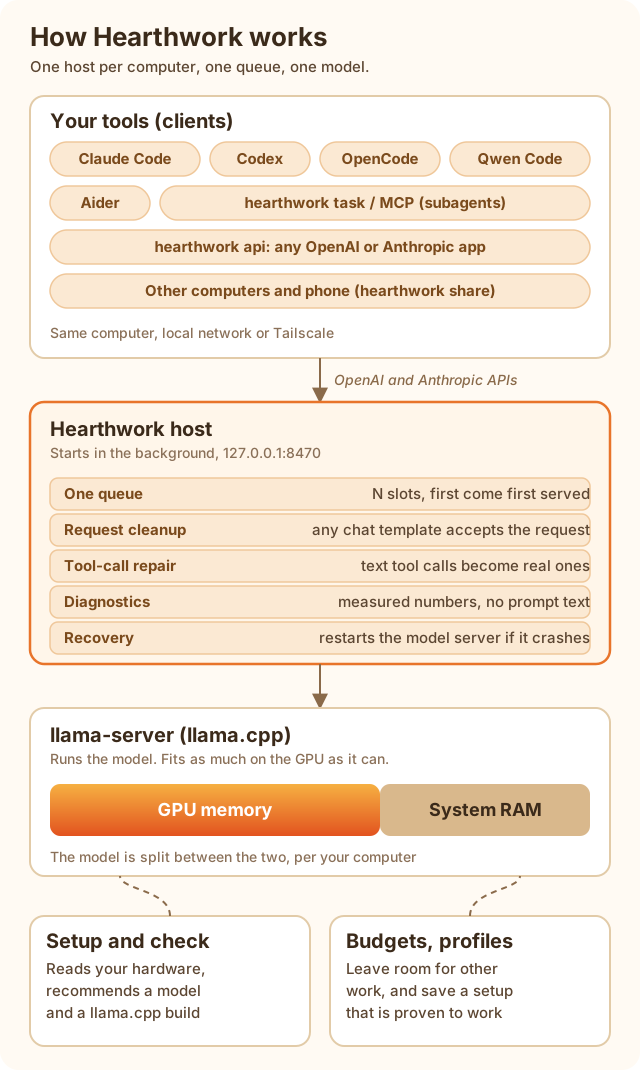
Section titled “One host per computer”hearthwork start, or any command that needs the model, starts the Hearthwork host in the background. The host owns llama-server and the single relay and request queue that every client goes through: agents, task and MCP, hearthwork api and hearthwork share.
- It listens on
127.0.0.1:8470. Each agent session identifies itself with a token likelocal-claude-ab12. - The model keeps running between agent sessions, and nothing opens a window.
- A model started by an older Hearthwork is adopted, not restarted.
The pieces
Section titled “The pieces”- The relay: the queue, request cleanup and tool-call repair.
- Context and models: how context is sized, how layers are placed on the GPU, and how models are recommended.
- Faster first messages. Each agent’s processed system prompt is saved to
cache/slots/when a session ends or the server stops, and restored when the server starts. - Settings live in the
serversection ofconfig.json.hearthwork setuprecalculates them, andhearthwork start --model Xor--context Noverride a single run. - Recovery keeps the model server running. See Recovery.